Paradis: Recto Verso
Photo gallery
6 images
0.0
0.0
Reader Score
No score yet, be the first to add.
0.0
Genre:
Electronic
Label:
Barclay
Release Date:
2016
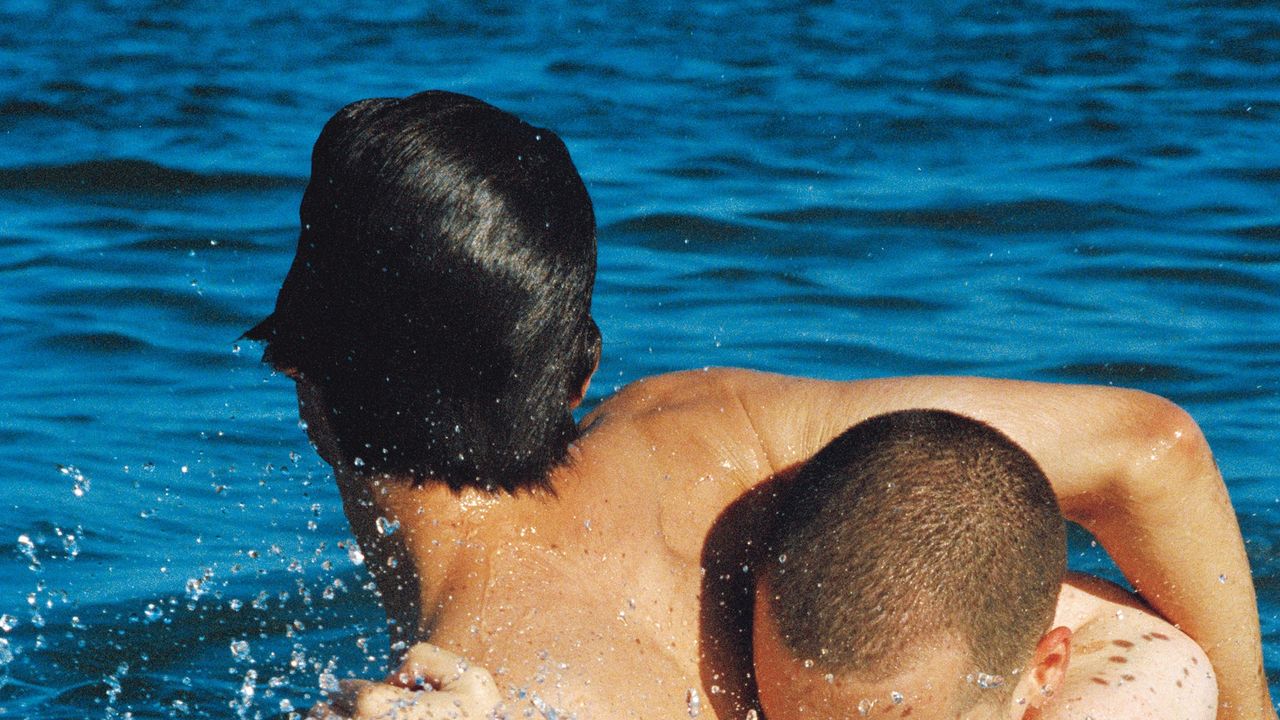
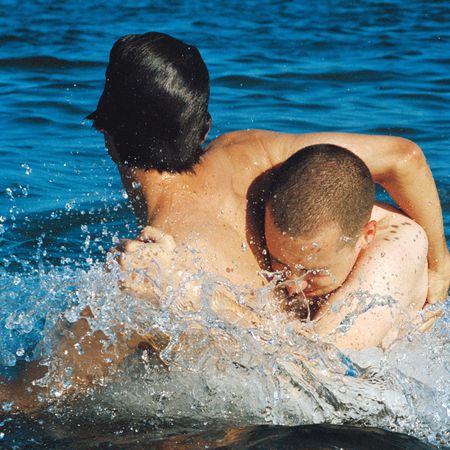
Imagine you’re young and beautiful. You’re on a beach with someone you like. It’s the hour of exquisite light, beyond gold: an ambergris hour. Imagine you’ve got a toned arm around someone else, or that your head is tucked into someone’s muscled back. It’s fun; it’s a fight. The water is a color blue can only dream of. And all over both of you, the sea arrives in fluttering crashes of foamy white. Imagine those waves were now soundwaves. Wouldn’t that be paradise?
Or, in fact, Paradis? Because these soundwaves aren’t just beachy vibes. They are not the sunny downtempo playlist compiled for a stylish hotel lobby that you two repair to so you can dry off, tumble into bed, hit the bar. This is a louche sound, equal parts house-music-all-night-long and dark-night-of-the-soul. This is the sound of hand-holding at the disco and putting your head in your hands the morning after—the afternoon, more likely, that light way now too bright. A lot of artists tried their hands at this sound: Brooklyn’s Metro Area, Ontario’s Junior Boys, Cologne’s Kompakt crew, Tokyo’s Soichi Terada, and they did it very well. But nobody did it like the French band Paradis. On their one and only album, 2016’s Recto Verso, they rescued the unfashionable French tradition of vocal pop called chanson by floating it across this global wave of melancholic bodymoving. They shimmied globally and sang locally. The album cover boasts Andrea Montano’s photo of bandmates Simon Mény and Pierre Rousseau in the exact situation I asked you to imagine. In it, they could have been in Ibiza, or Fire Island, or Thailand, or Rio. But they were in the south of France. That’s the only place where Paradis was found.
No score yet, be the first to add.
0.0
Rousseau had arrived in Paris in 2010 to study; he met Mény at a party. “He knew people, we went to the right bars, the right concerts,” Rosseau told the French magazine Tsugi in 2020. “It truly was an instant friendship.” Instantly productive, too. Each was already making instrumental music on their own. “We realized that we had very similar approaches and, above all, very similar desires,” he told Bible urbaine in 2016. “So in the days that followed, if not the very next day, we decided to create music together.” They’d go out dancing, then come home and try to reimagine what they’d heard.
But they were also listening to chanson, and not just the kicky first wave from the swinging ’60s, whose joie de vivre could lightly be heard in the phrasing of Stereolab’s Laetitia Sadier, or the slightly campy collabs between Saint Etienne and Étienne Daho, or the rare Air song en français. They liked the ’80s stuff, the adult-contemporary slick fromage that only Céline Dion would touch. And they held it all dear. “Singers like Alain Chamfort or Étienne Daho were, for us, part of the canon of what sounds good,” Rosseau said. After dark chez Mény, they christened themselves Paradis and made a cover of Alain Souchon’s “La Ballad de Jim,” a shimmering tale of the death of a father. They recast the chanson antecedent into their own kind of schaffel, an ambling, triplet-driven style of electro-pop popular among Kompakt artists like Superpitcher. But Paradis swapped swing for swoon on their cover, and also on an original, “Parfait Tirage.”
They sent the demos to Tim Sweeney, whose epochal, tastemaking WNYC show Beats in Space had become a clubhouse for producers around the world who collected records to make music to put out on collectible records. As it happened, Sweeney was looking to start his own label. In 2011, the Paradis demos became his first release; a second pair of tracks, longer and slower and, perhaps, soggier, appeared on a 12" the following year. If they had become DJs, Paradis could have ridden the wave and secured a spot on the international dance circuit like Hot Chip, Soulwax, and others in the BiS ecosystem. Instead, they moved to the south of France and nobody heard anything for years.
Maybe they didn’t like the hype; maybe they needed the time to write; maybe there’s no need to question why young people might want some time in the sun instead of at work. Regardless, they returned three years later with three astonishing singles foregrounding their determinedly Francophonic sound. “La Bal des Oubliés” is an ooh-la-la of congas and kaleidoscopic bells. With its sample of “Declaration de Dinistre,” the 1973 French free-jazz classic, “Garde le Pour Toi” soundtracks Brigitte Fontaine going to Panorama Bar. And in “Sur Une Chanson en Français,” a guiro seems to swim upstream against a boogie current while a trumpet plays down the sunset, as Mény intones a Paradis raison d’être: “Let her go out tonight… and finally live out her excesses… to a song in French.”
The major label Barclay, home to swanky post-chanson singer Sébastien Tellier, came calling. “We were tempted to see if our music could resonate with a wider audience,” Mény said recently. Barclay released the songs, along with credibility-enhancing remixes by DFA’s Tim Goldsworthy and Superpitcher himself, as 2015’s acclaimed Couleurs Primaires EP. Finally, in September 2016, Recto Verso arrived in its eye-catching sleeve. The album cast a net around contemporary club and after-party sounds and found a few pearls; it continued to assert that chanson was a treasure chest and not an anchor around French necks—and also that the strategies lately adopted by their countrymen to make it big (Daft Punk’s blockbuster self-mythologizing; Yelle’s YOLO partygirl schtick) were not for them at all. Each of its 12 songs is a kind of bubble, ephemeral but sound in structure, its scientific genius almost invisible until the light shifts and it goes technicolor. Every hook catches the ear. Every riff needs to be there. Every goddamn font is a delight. What is the French word for gesamtkunstwerk and is that also Paradis? Recto Verso, like its cover photo, is a split second made eternal through expert craft. And like the moment the picture captures, the magic wouldn’t last.
“Garde” takes pride of place, but the rest of the songs are brand new. Cyprien Sorel’s trumpet reappears on the elegiac title track, soaring like a seagull over Mény’s billowing harmonies, themselves secured by a clever bass boom and a trap breakdown that secures the ending like a cleat. The tide of chanson returns in the form of a cover of Alain Chamfort’s 1981 “Paradis”; whether or not the pair took their name from the song, they certainly took the song’s alienated new-wave ache and made a crisp boogie signature of their own. Contemporary inspiration arrives via an interpolation of Cale Park’s vaporwavey “N1,” just a few years old when Paradis smoothed it out into “Countours,” a Sade-slow ballad towards the end of the album meditating on fog machines and forgiveness.
And then there’s what should have been their big world-beating hit. “Toi et Moi” is pop music so expertly constructed it sounds effortless, from its adorable little break of a beat to its glamorous synth strings to its hook of chiming bell. But it’s also ambivalent, happy-sad in mood yet lyrically self-interrogative, if not self-destructive. “Et je sens bien que je m’y prends mal,” Mény sings in an elegant lilt, “Que tout ça c’est pas normal/Que tu voudrais la version sous-titrée.” (“And I feel like I’m doing it wrong/That all this isn’t normal/That you would like the subtitled version.”) This is disco cultural criticism par excellence. If they’d made this song in English, and about a girl, Paradis might have risen like Phoenix.
Instead, they made their own minimalist magic. Grand opener “Instantané” and slick throbber “De semaine en semaine” likely both make earworms from the same crystalline keyboard, and the epic Balearic “Mieux que tout” might make arpeggiated blurs of it. In the seductive “Quand tu souris,” Mény pulls a blanket of electric piano around him as he murmurs, “We’d say easy things to each other… amused by the exercise in style.” In the chippy, 2-steppy closer “Chacun pour soi,” those blankets are thrown to the (dance)floor and disappear like plumes of smoke. The best tracks even use the same title. “Miroir (Un)” is unmoored by bass and paralyzed by long strands of synth echoes that sound exactly the way regret feels; “Miroir (Deux)” turns those strands into party streamers. “I’m looking even if it exhausts myself/For a song like a mirror in which I can see myself,” Mény sings in both songs. Part one is Camus fronting late-era Cocteau Twins; part two is Celeda and Danny Tenaglia realizing in real time that music is the answer to your problems. Paradis devised a formula of “what sounds good” and made it sound even better by being themselves. And so Recto Verso is also a triumph of personal taste, manifested in their almost mystical prowess with hooks, and embodied in a ritualized faith in repetition as enthusiastic emphasis, not resource draught.
Those songs were also bubbles in that when Paradis put too much pressure on them, they popped. “We were computer and bedroom musicians,” Mény laughed in Bible urbaine. The label wanted them to tour, to give in to that temptation to search for wider resonance, so they enlisted another keyboard player and live drummer. The rock-forward style made their relationship rocky. “We hadn’t imagined sharing our music in public like this; it was both very unsettling and fascinating,” Rosseau recently told Les Inrockuptibles. The pair began arguing. “By the end of the tour, things had become more complicated between us,” he said. Mény added, simply: “There was no music afterwards.”
Or, at least, no Paradis. Mény released a track or two over the next decade; Rousseau put out a pair of EPs and produced songs for Metronomy and Air’s Nicolas Godin. Recto Verso sank. And then, somehow, arose in the age of streaming. Paradis haven’t yet had their make-a-dance-to-this moment, or their big TV sync. Chanson sure as hell hasn’t been revived without them. “Toi et Moi” has been heard dozens of millions of times, if you believe Spotify. Je ne sais pas. Except that, once you’ve heard these songs, you’re going to want to hear them again. One moment, they’re not bad, and then they’re the best thing ever. A moment in the sun becomes a time you’ll never forget.
The album’s existential take on tasteful dancefloor pop succeeds so wildly, I think, because of its specificity. The future is local. Personal too: With its perfect packaging and lack of follow-up, Recto Verso is an immaculate cult object. Original pressings rose into the thousands of dollars on Discogs. And then, suddenly this summer, Paradis was regained. Like a message in a bottle, a 3xLP Recto Verso set washed up, containing almost everything the pair released. A love letter, maybe. Or a farewell. Only their remixes are missing, and only a new set of “Toi et Moi” remixes by Chicago house legend Mr. Fingers is promised. They extend the songs into nostalgia. Meanwhile, the reissue traps Montano’s photo, with all its emotional and erotic immediacy, within a thick frame of white. The flash is at a distance now, like an archive of pleasure’s potential. A holiday a long time ago when you danced to songs in French, without subtitles, with each other. Well, imagine that.
0.0
0.0