Goodbye Karoline: A Look Back At The Press Secretary’s Worst Podium Moments
Photo gallery
6 images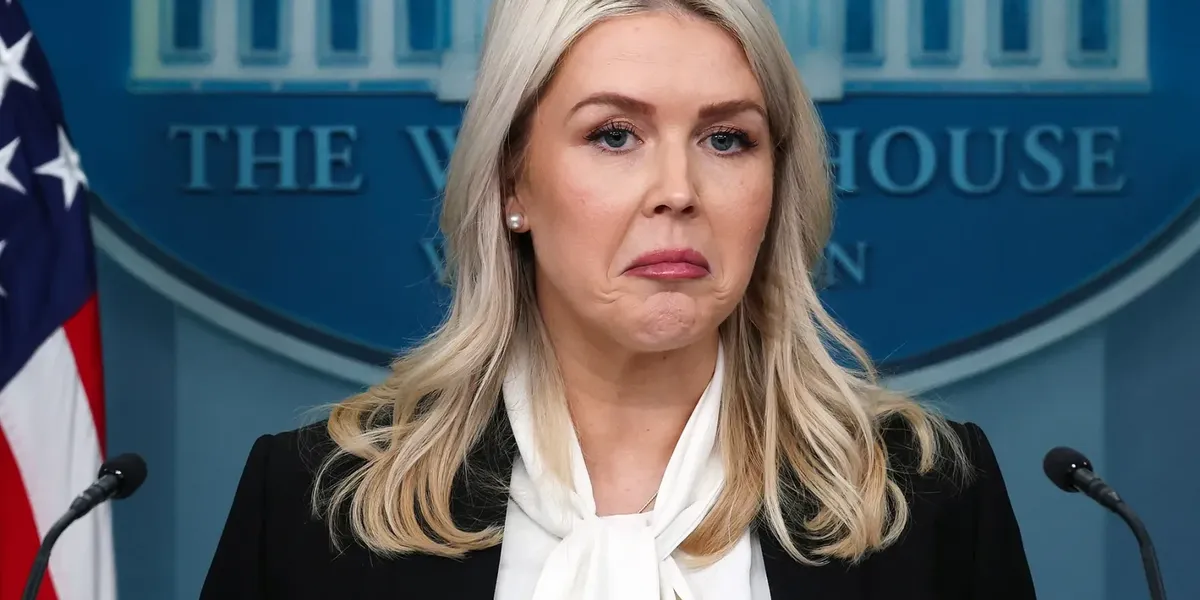

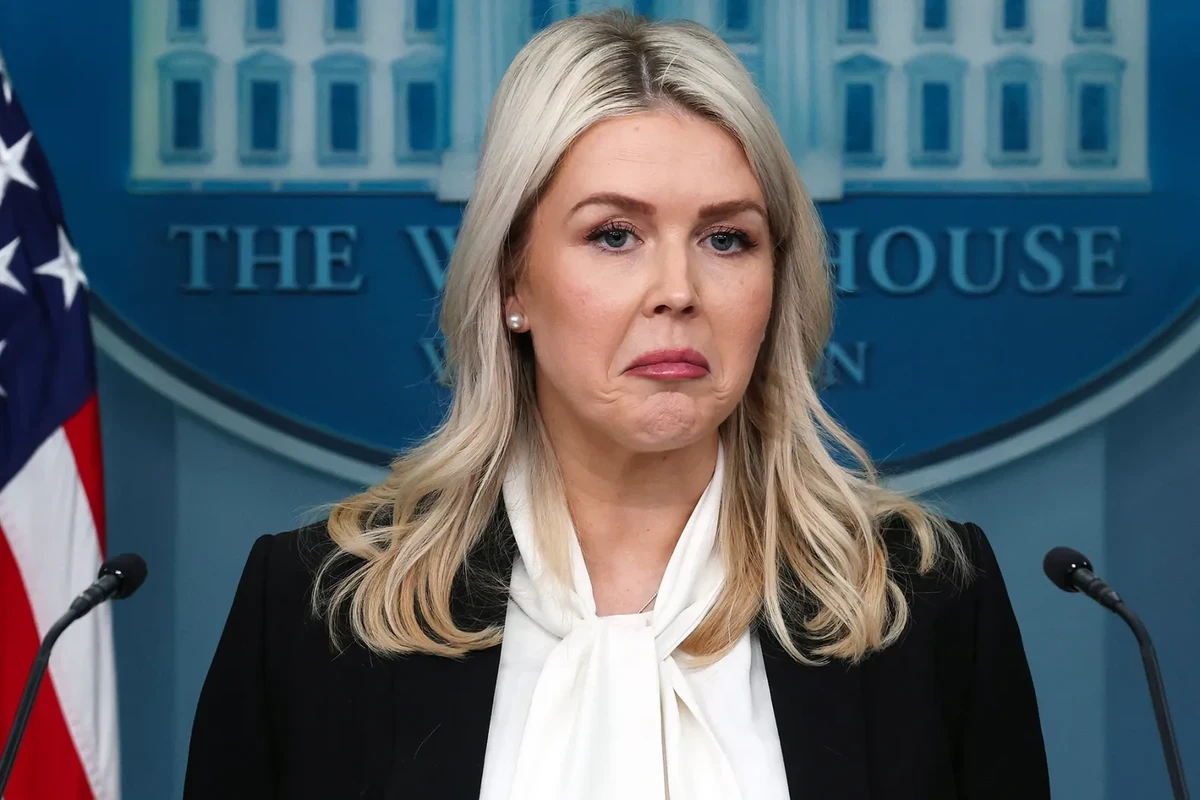
The youngest press secretary in history made a name for heself as Trump's attack dog in his crusade against the First Amendment
White House Press Secretary Karoline Leavitt reacts during a news briefing at the White House on March 04, 2026 in Washington, DC.
Goodbye Karoline Leavitt, we wish we’d known you less. After 585 days serving as President Donald Trump’s Press Secretary — the second longest tenure of the five he’s had while in office — Leavitt is stepping down from her role to spend more time with her two young children.
Speaking to reporters on Thursday, Leavitt described her departure as “bittersweet.â€
“I’ll miss you guys. I know that’s probably not something anyone would expect me to say, but obviously it’s been great working with all of you,†she told a gaggle of White House correspondents. What “I think people don’t realize about this job — the briefings and what I just did on TV — is 10 percent. Ninety percent of it is taking all of your calls at five in the morning and 11 p.m. at night, and I won’t really miss that. But I will miss working with you guys every day.â€
At 29, Leavitt is the youngest press secretary Trump has had over the course of the two terms — and the youngest in the position’s history. She has been in the post since Trump retook the White House, and quickly became one of the most recognizable faces of Trump 2.0’s push towards increasingly authoritarian and inhumane policies, and the primary laundress of the administration’s overreach and misinformation.
Her successor has not been named yet — although plenty of right-wing blowhards are vying for the position. In the meantime, here’s a look back at some of the lowest lows Leavitt delivered to the nation from behind the White House podium.
The Epstein scandal was a “manufactured hoax by the Democrat Partyâ€
Leavitt infamously claimed that the Epstein files, and the scandal surrounding them, were a hoax manufactured by Democrats. At one point Leavitt went so far as to imply that individual documents released by Epstein’s estate were potentially fabrications, defending Trump’s claim that a birthday card depicting a nude female figure drawn by Trump for Epstein was potentially a forgery.
Claiming Renee Good was a “lunaticâ€
After the killing of Renee Good in Minneapolis, Minnesota by ICE Agents, the administration jumped into spin mode. From the White House podium, Leavitt berated a reporter and called her a “left wing hack†after she questioned the administration’s description of Good as a violent instigator who had justifiably been shot. Leavitt later called Good a “lunatic†in a press gaggle with White House reporters.
Accusing the press of only wanting to “make the president look badâ€
In March, less than a month into the American war against Iran that was only supposed to last a couple weeks, Leavitt berated CNN host Kaitlan Collins for pressing her on complaints by Defense Secretary Pete Hegseth about negative coverage of the deaths of six service members.
“It’s the position of this administration that the press in this room and the press across the country should accurately report on the success of Operation Epic Fury,†Leavitt said. “The press does only want to make the president look bad. That’s a that’s a fact,†she added.
“The president is literally constantly shaking handsâ€
When mysterious black bruises began to appear on the back of President Trump’s hands (along with really shoddy efforts to cover them with makeup) speculation grew that the president’s health might be in visible decline.
The White House offered up another explanation: Trump was constantly participating in crushing hand shakes with important people. “The president is literally constantly shaking hands, the Oval Office is like Grand Central Terminal,†she claimed, adding that the bruises were likely made worse by Trump’s daily aspirin regiment.
Insisting that the “body of water off of the coast of Louisiana is called the ‘Gulf of America’â€
Trump loves renaming things. Early on in his second term, the president made a show of attempting to rename the Gulf of Mexico as the “Gulf of America.â€
“It is a fact that the body of water off the coast of Louisiana is called the ‘Gulf of America,’†she snapped at reporters.
News outlets refused to adopt the change, leading the administration to attempt to ban the Associated Press from the White House Press pool. They were later reinstated via a judicial order.
Claiming millions were being spent on “condoms in Gazaâ€
Leavitt falsely promoted claims by the administration that — under Elon Musk — DOGE had prevented $50 million from being spent distributing “condoms in Gaza.†It turns out no such funding allocation existed, although the administration did cut a total of about $100 million in humanitarian aid programs to the region.
Blaming DEI and “skin color†for a plane crash
Following a deadly crash between a military helicopter and a passenger jet over the Potomac river that killed 67 people, the administration attempted to claim that the crash had been caused by “DEI†ideology producing underqualified pilots.
When you are flying with your loved ones,†she asked sarcastically, “do you pray that your plane lands safely or do you pray that the pilot has a certain skin color?â€
LOS ANGELES - 1978: Country singer Dolly Parton poses for a portrait session in 1978 in Los Angeles, California. (Photo by Harry Langdon/Getty Images)
Presidents across party lines celebrated Dolly Parton on Tuesday following her death, speaking to the country icon’s ability to transcend politics through her work that often spoke louder than words.
On Tuesday, former Presidents Bill Clinton, Barack Obama, and George Bush each paid tribute to Parton, while President Donald Trump ordered that flags be flown at half-staff for the next week to honor “one of the greatest Country singers, and far beyond, EVER.â€
In their statements, the former presidents praised both Parton’s music and philanthropic endeavors. In 2020, Parton donated $1 million to Vanderbilt University, which helped fund coronavirus research and Moderna’s Covid-19 vaccine. The legendary singer also famously founded the Imagination Library, established in honor of her father Robert Lee Parton Sr., which distributes books to children in multiple countries.
In a statement posted on social media, Obama highlighted Parton’s humble roots, colossal impact in music and Hollywood, and her philanthropic work. “It’s hard to imagine many people having a bigger impact than Dolly Parton. Born in a one-room cabin, she earned 11 Grammys and an Emmy, built a business empire, helped millions of kids learn to read, and — as if that wasn’t enough — helped accelerate the research that led to the Moderna COVID vaccine,†Obama wrote. “What a life. Michelle and I are thinking of Dolly’s family and her many, many fans.â€
See on Instagram
“Dolly Parton was one of a kind—a great songwriter and performer who told the stories of everyday Americans with honesty, humility, and heart,†wrote Clinton in another tribute. “She rose high from her East Tennessee roots and never forgot where she came from. And she always believed in giving back, especially in her efforts to promote literacy. Hillary and I were big fans and first saw her in 1974, and will always be grateful for the music and the memories.â€
Bush and former first lady Laura Bush also joined fans in mourning Parton’s death. “We loved her music and her style. She was a great entertainer and even greater person,†wrote the former president. “We respected her work to promote literacy, advance health, and strengthen communities. Dolly was a talented and hardworking American who will be missed.â€
Rather than taking a hard line on politics, Parton chose to shine a light on her values through both her work and own endeavors. The icon, a beloved supporter of the LGBTQ community, wrote and sang the Oscar-nominated song “Travelin’ Thru†from Transamerica, a 2005 movie about a transgender woman and her son. In 2017, Parton collaborated with her goddaughter, Miley Cyrus, to record “Rainbowland,†a hopeful tribute imagining a world of complete inclusivity and equality.
When speaking to Rolling Stone about the track the year it released, Parton called the song “one of those things we felt like the world needed a little message right now.†She continued, “If we could just do a little better, try a little harder, try to get along a little better, we could live in Rainbowland. If nothing else, if we tried a little harder at least we’d be a little more colorful than it is right now, a little brighter, a little shinier out there.â€
Trump has escalated his conflict with one of the country's staunchest allies.
In the absence of a coherent political strategy, threaten something ridiculous. Such has been the strategy of the Trump administration in virtually every major foreign policy and economic decision of his second term. As relations with Canada — our northern ally and major trade partner — collapse into a trade war spurred by the American president’s tariff threats, things have once again escalated into the absurd.
On Tuesday morning, President Donald Trump took to Truth Social to goad Canada, writing that “the United States is giving serious consideration to changing the name of Lake Ontario to Lake America in that we don’t expect to be doing much business with Ontario any longer.â€
The threat mirrors Trump’s claims that he holds the authority to rename major global geographical features at will. Notably the president has attempted to rebrand the Gulf of Mexico as the “Gulf of America,†It’s all a part of a larger imperialist impulse on Trump’s part. The president has floated invading and annexing Greenland, Venezuela, and Canada, claiming he will make each the “51st state.â€
“Over the last 10 years, the United States lost, on average, 60 Billion Dollars a year with Canada. No more,†he added in a subsequent post — which misrepresented the annual import/export differential between Canada and the United States as a “loss†and not an exchange of goods.
Americans can count the death of North American free trade among the many casualties of the second Trump administration. Earlier this month, Trump threatened to level punishing, 50 percent tariffs on over $20 billion of Canadian imports. Canadian Prime Minister Mark Carney has threatened dollar-for-dollar retaliatory tariffs.
“In recent days, the United States proposed new terms that were uneconomic, unfair, and undermined the net benefits for Canada and called into question the reliability of any deal,†Carney said on Sunday. “In short, they asked too much and they offered too little. You’re at war when you get attacked. We got attacked.â€
Canadian goods account for approximately 10-15 percent of all U.S. imports, and is the nation’s second biggest trade partner by volume after Mexico. With costs for everyday goods continuing to rise, and an affordability crisis threatening Republicans’ unified party hold on Congress after the midterms, a trade war with a historic ally comes off as wholly idiotic. Maine Senator Susan Colling, a Republican facing a tough reelection bid in a state that borders Canada, said in a recent interview that “imposing new tariffs on Canada is a mistake.â€
In a post on social media, she warned that continuing down this path “will increase costs for Maine families, as most businesses will have no choice but to pass on the tariffs to their customers through higher prices.â€
Ontario Premier Doug Ford has threatened to cut off energy exports to the United States from Ontario, telling reporters on Monday that “everything is on the table,†and that Americans “won’t get a grain of sand†out of the province that powers millions of homes in the United States if things continue to spiral.
As for the American president, he had some choice words.
Trump can “â€kiss my ass.â€
Donald Trump in the Oval Office in August 2026.
President Donald Trump told the Department of Justice to settle its antitrust suit with Live Nation after meeting with CEO Michael Rapino in the Oval Office in late February, The Wall Street Journal reports.
The new story digs into the lobbying efforts and behind-the-scenes maneuvering that preceded Live Nation’s surprise settlement with the DOJ in early March, just one week into the company’s federal antitrust trial. While some co-plaintiff states signed onto that deal, many continued with the case, and a jury ultimately found Live Nation liable for operating as a monopoly in April.
The Wall Street Journal previously reported that the settlement was reached after a meeting at the White House on March 5 attended by Rapino, the company’s lawyers, and DOJ officials (including former Attorney General Pam Bondi). But Rapino had also met with Trump a few weeks earlier.
According to the report, Rapino’s Feb. 27 meeting at the Oval Office primarily centered around Trump’s efforts to overhaul the Kennedy Center, and the president’s desire to enlist Live Nation to handle the venue’s operations. But during the meeting, the president also asked Rapino why the company hadn’t settled its antitrust case with the DOJ yet. After, Trump reportedly directed the DOJ to strike a deal.
Reps for Live Nation did not immediately return requests for comment. Lauren Bis, a White House spokesperson, said, “Unlike Joe Biden, President Trump has not weaponized the Department of Justice against his political foes or used it to help his friends. The Department is focused on restoring law and order and keeping Americans safe.â€
The DOJ’s settlement with Live Nation has drawn significant criticism, both for how the deal was reached, and the terms it contains. While it did force some concessions from Live Nation on key issues involving its amphitheater business and Ticketmaster’s exclusivity contracts, many claimed it did not go far enough to address the company’s alleged monopoly over the live entertainment industry. For instance, the plaintiff states are currently seeking to force Live Nation to divest from Ticketmaster following their victory in court.
Dan Wall, Live Nation’s executive vice president of corporate and regulatory affairs, touted the terms of the deal in a new statement shared with the WSJ. “Our critics are comparing this settlement to the irrational hope of breaking up Live Nation and Ticketmaster,†Wall said. “For the actual claims in this case, the DOJ and settling states got as much or more as they could have expected to win in court.â€
He also defended Live Nation’s actions as it worked to reach a settlement with the DOJ: “The only reason we went above the Antitrust Division to senior DOJ leadership is because no one there would speak to us. When you’ve been unable to get a meeting for six months, you have every right to try something else.â€
Live Nation made significant efforts to lobby the DOJ and Trump administration into dropping, or settling, the antitrust. The company worked closely with many people close to the president, including Kellyanne Conway and MAGA influencer-lawyer Mike Davis (who previously helped lobby the DOJ to drop its challenge to a $14 billion merger between Hewlett Packard and Juniper Networks). And Trump involved himself reportedly after hearing about the case from prominent people.
According to the WSJ, Live Nation’s efforts also included hiring top law firm Sullivan & Cromwell to lead its settlement talks. The Sullivan & Cromwell team reportedly included two antitrust experts, but also a lawyer named James McDonald, who had little antitrust experience, but was representing Trump in his criminal cases in New York. (In July, Trump appointed McDonald to lead the U.S. attorney’s office for the Southern District of New York.)
Additionally, two top political appointees at DOJ reportedly had an influence over an early set of proposed settlements. One pushed the lawyers at the antitrust division to remove language forcing Live Nation to sell Ticketmaster from a draft response; he and the other appointee also reportedly echoed talking points Live Nation had unsuccessfully tried in court.
As for the case itself, it’s now in the remedies phase, during which Judge Arun Subramanian will decide what kind of punishment Live Nation will receive. Subramanian also has to review and approve the DOJ’s settlement with Live Nation, and decide whether it was reached in the public interest. In a July letter to the judge, the plaintiff states said said they had “significant concerns†that it was not in the public interest, and asked the DOJ to share new details about how the settlement was reached.
Elon Musk posts incessantly about protecting Western civilization.
“She’s a traitor to the West.â€
Elon Musk posted this on X on July 25 in response to a clip of Zanny Minton Beddoes, editor-in-chief of The Economist, saying on CNBC that Musk propagates a “caricatured†image of Europe as a deteriorating, unlivable hell hole. Beddoes had recently interviewed Musk, challenging his views on Europe, and confronting him for supporting far-right politicians and parties from Germany to the UK. Beddoes never questioned the hallmarks of liberal democracy: free and fair elections, separation of powers, equal protection under the law, or human rights. But in Musk’s mind, her pushing back on his caricature of Europe as a continent colonized by immigrant invaders proved enough to make her a “traitor to the West.â€
The idea of “saving the West†isn’t limited to the feverish online posting of the world’s richest man. If one surveys the conservative media landscape on any given day, the call to “rescue Western civilization†appears ubiquitous. For example, on August 5, 2026, the day after Abdul El-Sayed won the Democratic primary for Senate in Michigan, the civilizationist discourse popped up in every corner of the American right. Podcaster Benny Johnson called for more politicians willing to “fight for Western civilization.†Al Mohler, president of the Southern Baptist Seminary, released a podcast interview titled “The Battle Western Civilization.†Mike Pompeo, former Secretary of State, posted: “The Democratic Party is being taken over by anti-American candidates who hate the values that underpin Western civilization.â€
Noah Rothman, senior writer at the National Review, posted in response to a video montage of Abdul El-Sayed: “This race isn’t just about tax rates, or health care, or immigration enforcement. It’s about more than politics now. This is a fight over America and whether the enemies of Western civilization are right.â€
None of this even touches the civilizationist outrage many on the American right — including Musk — expressed over the casting of Black actors in Christopher Nolan’s The Odyssey.
Civilizationalist discourse isn’t a new summer trend. It’s surged since Trump’s second inauguration. In a July 2025 interview, Lara Trump even asked her father-in-law about his supposed nickname, the “bodyguard of Western civilization.â€
I’ve spent the last two and a half years investigating the growing alliance among Protestant Reconstructionist Christians like Doug Wilson and Secretary of Defense Pete Hegseth; radical traditional Catholics like Kevin Roberts of the Heritage Foundation and Vice President JD Vance; and Silicon Valley technocrats like Elon Musk, Peter Thiel, and Curtis Yarvin. What’s become clear: “Saving Western civilization†is now the unifying rallying cry of the American right, surpassing Trump’s infamous “make America great again†slogan and even the Christian nationalist mantra of taking America back for God. There’s a reason for this change. As I argue in my new book American Caesar, the crusade to rescue Western civilization provides an umbrella discourse that unites tech reactionaries with traditional Catholics and extremist Protestants in a loose alliance against immigrants, non-Christians, the LGBTQ community, and anyone who criticizes the United States.
While extremist Christians and Silicon Valley technocrats often disagree on issues related to AI, surveillance, and family, they are aligned on the idea that saving Western civilization from external threats like Muslims and migrants and internal threats like antifa, trans people, and feminists is the paramount issue of our time. Even though Elon Musk is not religious, many Christian nationalists see him as an ally in saving Western civilization from the foreign and domestic vandals they believe threaten it. By couching their shared mission in civilizational, rather than religious terms, they can forge a loose coalition against the groups they perceive as common enemies and existential threats to “our way of life.â€
As opposed to Christian nationalism or MAGA, civilizationalism also provides a horizontal plane that transcends the United States, including Europe in the effort to rescue civilization from both attacking barbarians and domestic enemies.
In many ways, the civilizationalist discourse emanating from every corner of the American right is an escalation of the Christian nationalist currents that have been center stage during the Trump era. As the scholars Yilmaz and Morieson argue, “Civilizationism is an idea which posits that the world and its peoples can be divided into several ‘civilizations’, most of them defined by religion.†Western civilizationalists render “Western†people as moral, rational, and outright superior to others based on their religious-cultural values. This escalates MAGA’s hallmark xenophobia and Christian nationalism because civilizationalist discourse posits that “non-Westerners†“belong to a foreign civilization with inferior values derived from an inferior religion.†In other words, they are inexorably less than “us†as a people, and therefore unassimilable. There’s no room here for legal migration, pluralism, or multiculturalism. Rather, we are left with a vision akin to Samuel Huntington’s clash of civilizations model, wherein different people groups across the world hold competing values that can never be cohered. Moreover, American citizens who promote “anti-American,†“anti-Christian,†or “anti-capitalist†views are suspected of being linked to either Islamist, or communist foreign networks. They are a foreign enemy cosplaying as real Americans. The goal of civilizationism is isolationist purity. The strategy to achieve it? Civilizational warfare.
Thus, we arrive at a startling truth: When Christian nationalists and technocrats rally to “save Western civilization,†their efforts are not meant to shore up democratic institutions, reinvigorate civic norms surrounding free and fair elections, protect free speech, or defend free thought. When a Texas A&M professor was told he couldn’t teach Plato — the pre-eminent philosopher of ancient Greece and perhaps all of Western civilization (outside of Jesus) — without permission, there was no uproar. When books are banned, the civilizationalists don’t blink.
Their retrieval of Western virtue is not focused on the merits of Athenian democracy or the Roman Republic, much less the Enlightenment values of free choice, personal autonomy, or freedom from religious imposition and/or censorship. In this case, saving Western civilization doesn’t mean empowering We the People, it means rescuing the country from the “immoral elites†who have sold out our country to inferior foreigners; the domestic infidels who refuse to abide by the binary gender and sex norms that both technocrats like Musk and Christian nationalists like Vance and Hegseth prescribe.
If a pure society, rather than a free one, is what they are trying to save, we are left with an important question: Who is going to do the rescuing?
There has been plenty of extremism among Christian nationalists for decades. However, what we are witnessing now is frightening escalation to something more radical: the desire to replace We the People with an all-powerful leader to purify the United States — a Red Caesar, a Protestant Franco, an Appalachian Pinochet, an Unbound Executive, or a Tech Monarch. In other words, a second American Revolution, but this time to seat someone like a king, rather than to break away from one.
There is an abundance of evidence that Trump and his allies are trying to manifest something resonant with these models. Elon Musk’s implementation of DOGE early in Trump’s second term echoed the tech-dissident Curtis Yarvin’s notoriously monarchist ideals. When he took the helm of the so-called Department of Government Efficiency early in 2025, Musk began implementing a “hard reboot†of the government following Yarvin’s blueprint. Musk’s DOGE lieutenants openly claim Yarvin as their greatest philosophical inspiration for gutting federal agencies, laying off workers, and destroying the social safety net. One DOGE team member told The Washington Post that Yarvin represents “the most crisp articulation†of what DOGE is trying to achieve. Another said that “it’s an open secret that everyone in policymaking roles has read Yarvin,†and are using his authoritarian theory “to empower people on the ground to actually do stuff — even if they can’t admit it publicly.â€
There is more evidence in the form of Trump’s defiance of the courts, particularly when it comes to his effort to rid the nation of the kind of external threats so often cited by Musk and his fellow guardians of civilization. An Associated Press review from May 2026 found that in 31 lawsuits his administration had “250 instances of noncompliance†in immigration cases, “from failing to return property to keeping immigrants locked up past court-ordered release dates.â€
The list goes on: The Trump administration kidnapped and imprisoned Nicolás Maduro from Venezuela and took control of the country’s oil. Now, Marco Rubio is ruling the country from afar with no plan for elections any time soon. To date, Trump has not received congressional approval for the war with Iran, which has been ongoing since February. Trump tried to rename the Kennedy Center. He demolished the East Wing of the White House. And his former personal defense attorney, Todd Blanche, was just appointed head of the Department of Justice. Oh, lest I forget: Trump ignored the Constitution completely when he tried to deport U.S.-born Americans.
The move toward an American Caesar, in many respects, is no longer a Christian nationalist movement, at least not in the way we often think of it.
The dream of the right is no longer to restore a time when white Christianity went hand in hand with America; a restoration of the supposed pax Americana of the 1950s. The outlook now is more grim and more extreme.
In the face of demographic change, cultural progress, and global crises, Christian Reconstructionists, reactionary Catholics, and Silicon Valley magnates long to “save†Western civilization by replacing American democracy with a post-constitutional Caesar who will rule without the burden of checks and balances or the sharing of power in any meaningful way. Trump is doing everything he can to oblige them.
Bradley Onishi is author of American Caesar: How Theocrats and Tech Lords Are Turning America Into a Monarchy, on sale September 15 via Macmillan Publishers.
Anthony Fauci listens to a question during a press briefing at the White House, on April 13, 2021, in Washington, D.C.
Over and over, Dr. Anthony Fauci, an infectious disease doctor who led the National Institute of Allergy and Infectious Diseases for 38 years, invoked his Fifth Amendment rights during a highly anticipated hearing before the Senate Committee on Homeland Security and Governmental Affairs (HSGAC).
“On the advice of counsel, I respectfully decline to answer based upon my rights under the Fifth Amendment to the Constitution,†Fauci repeated over the course of three hours in answer to every question from Republican and Democratic senators alike, looking alternately pained and stone-faced.
It was a spectacle that illuminated the deep and lingering ideological divide over America’s broken Covid-19 response, while shedding little light on the consequential question of how the pandemic began.
In a storied public health career in which he advised seven presidents, Fauci led the response to the HIV/AIDS crisis, helped craft the PEPFAR program, which allowed the U.S. to fund lifesaving AIDS drugs for Africa, and led America’s response to the Covid-19 pandemic.
His testimony on Wednesday came as part of an ongoing campaign by Senator Rand Paul (R-Ky.), who chairs the HSGAC, to uncover information about the origins of the pandemic as well as scrutinize Fauci’s role in leading the response. Paul recently released new documents, which include over 1,000 pages from Fauci’s personal diaries to private Slack messages between virologists allied with him to a transcribed interview with Dr. Ralph Baric, one of the world’s leading coronavirus researchers. Baric had pioneered techniques used by the Wuhan Institute of Virology, including one that allowed researchers to invisibly splice components of viruses together without leaving a trace
Health Secretary Robert F. Kennedy Jr., who vilified Fauci in his conspiratorial 2021 book, The Real Anthony Fauci: Bill Gates, Big Pharma, and the Global War on Democracy and Public Health, obtained Fauci’s diary entries from government servers and gave them to Paul’s committee. On X, Kennedy’s sister Kerry Kennedy called the release of Fauci’s diary a “clear violation†of Fauci’s privacy. RFK Jr. argued that the diary entries were not private, as they were composed on government computers.
MAGA politicians and right-wing influencers have long sought to recast Fauci as an arch villain, aiming to blame him both for sparking the pandemic and restricting freedoms during it, at a time when every country wrestled with the difficult questions of balancing individual liberties with protection of the most vulnerable, especially before the development of a Covid-19 vaccine. They have aimed to imprison him, or at the very least prove that he deceived the public. The 85-year-old scientist, once hailed as a hero, faces continuous death threats and now pays for his own security detail.
As Senator Richard Blumenthal (D-Conn.) said to Senator Paul at the hearing, after he had ejected Fauci’s attorney when he tried to sit at the witness table, “You are single-mindedly fixated on seeing Dr. Fauci prosecuted for imaginary crimes, and you are so invested in that outcome that you have created a personal brand around it.â€
But as more documents have emerged through freedom of information requests, subpoenas and declassification, it is also clear that Fauci championed risky virology research, his institute helped fund some of the Wuhan Institute of Virology’s most controversial known experiments, and worked behind the scenes with a small group of top virologists to steer the evolving public narrative away from a laboratory origin, once the pandemic began.
More than six years later, there is still no “smoking gun†proof for either of the two prevailing hypotheses of Covid-19’s origins, that SARS-CoV-2 emerged from a laboratory accident at the Wuhan Institute of Virology or from a natural jump from an infected animal. Nor is there direct evidence linking Fauci, or research at the WIV that NIAID funded while he was director, to the pandemic.
In the last few months, however, a release of new documents, some partly declassified by the Office of the Director of National Intelligence under Tulsi Gabbard, and some obtained by Senator Paul’s committee through subpoenas, show that, even as leading scientists and certain government officials, including Fauci, publicly argued against a lab leak, in private, at various times, they deemed it credible and even equally likely.
Their assessment came in part due to unusual features of the virus. Those include a furin cleavage site, a distinctive segment of SARS-CoV-2’s genetic code that makes the virus more infectious by allowing it to more efficiently enter human cells, raising the question of whether the virus was engineered.
Since 2023, both the Department of Energy and the CIA have shifted their assessments towards a lab leak as the likelier origin, joining the FBI, which was the first intelligence agency to assess with moderate confidence that SARS-CoV-2 originated from a laboratory accident. Four intelligence agencies, along with the National Intelligence Council, assess a natural origin for Covid-19.
One thing that also clearly emerges from the documents: as the world was engulfed by crisis, and the American public needed transparency, the effort by Fauci and scientists allied with him to obscure or downplay the U.S. government’s entanglement with the Wuhan Institute of Virology likely weakened America’s ability to pressure China to release more information.
On January 26, 2020, as the virus was emerging, Fauci wrote in his journal, “Now we know the [Huanan seafood] market was not the source, it was the amplifier. Having said that, somewhere the virus jumped from animals to humans.†The scientists allied with him would later argue that the market was the pandemic’s origin, serving as the spot where the virus first leapt from an infected animal to humans. (No infected animal has ever been identified.)
In his diary, Fauci then mentions a February 1, 2020 conference call, one that later became the subject of intense scrutiny. He had gathered top virologists to discuss the origin of the virus. His entry makes clear that the majority on the call “felt that deliberate insertion†of a furin cleavage site “was possible†due to the type of risky research the WIV had been pursuing. “We could not let this go.â€
Yet by March of 2020, they had let it go. Four of the scientists on the call, all of whom had raised concerns about a lab leak, and a fifth author, published a scientific letter in Nature Medicine, “The proximal origin of SARS-CoV-2,†asserting that “any type of lab-based scenario wasn’t plausible.â€
Emails obtained through freedom of information later showed that Fauci had worked behind the scenes to help shape the publication. But at the time, his role in the letter was not publicly known.
On April 17, 2020, at the White House podium, Fauci fielded a question from a reporter: Could SARS-CoV-2 have come from a lab? He responded that a recently published analysis from a “group of highly qualified evolutionary virologists†had concluded that the virus was “totally consistent with a jump of a species from an animal to a human.â€
That positioning of the Proximal Origins letter played a significant role in relegating even factual questions about the possibility of a laboratory accident to the conspiracy-theory dustbin. To this day, there remain unanswered questions about what led the scientists involved to shift their assessments between the February 1 call and the publication of their lab-leak disavowal some six weeks later.
“These guys were messaging each other about how the virus looked like it was engineered and then after speaking with Fauci, switched gears quickly and published the Proximal Origins letter,†Jason Bannan, the FBI scientist who led the Bureau’s investigation into Covid-19’s origin, tells Rolling Stone. Meanwhile, he says, “Fauci was advising [the intelligence community] to listen to those experts, so he continued to promote them.â€
In May 2020, one month after Fauci touted the Proximal Origins paper and its conclusion of a natural origin from the White House podium, the Z division of the Lawrence Livermore National Laboratory — an elite group of federal government scientists who advise the intelligence community — issued a classified report which argued that an accidental lab leak was equally possible.
“We assess all of the necessary conditions for an accidental release of a laboratory-modified coronavirus — specifically a coronavirus adapted to recognize human cell receptors — were present at the Chinese Wuhan Institute of Virology (WIV) in mid-to-late 2019,†the report states. “As a result, we place equal weight on the hypothesis that the COVID-19 virus was a result of laboratory modification, along with that of a natural outbreak or the release from a laboratory of a naturally occurring virus.â€
Though the report, recently released by the Office of the Director of National Intelligence, remains heavily redacted, it states that the WIV could have possessed precursor viruses that were genetically similar to SARS-CoV-2, could use reverse genetic systems to modify coronaviruses, was testing to see if related coronaviruses could enter human cells and could have accidentally released the virus.
In private, as revealed in Slack messages released by Senator Paul, the scientists allied with Fauci were assessing similar possibilities.
In June 2020, Kristian G. Andersen, director of Infectious Disease Genomics at the Scripps Research Translational Institute in California, told his colleagues on a Slack message chat, “The part I’m really struggling with is that at the end of the day, we really don’t have any hard evidence one way or the other — and especially given some of the recent evidence, we also can’t rule out that somebody actually put [the furin cleavage site] in there…. Our paper was pretty strong in saying, ‘There’s no way,’ but I have less confidence in that statement at this stage.â€
He took issue with the accuracy of their own Proximal Origins letter, stating, “We’re dealing with the fact that WIV had been doing culturing of bat [coronaviruses] for over a decade exactly to understand what it takes for these viruses to emerge in humans [in biosafety level 2). We describe this in the paper and say that this work is performed “all of the world,†but that isn’t true — it has exclusively been going on at WIV.â€
He then admits that in the absence of data, “I find both scenarios to be equally probable.â€
Despite the scientists’ public assertions that there was a scientific consensus of a natural origin, Andersen writes that since publishing Proximal Origins, “I have explained to a ton of scientists (and policy makers) over and over again why this is a natural virus, and I have been pretty surprised to learn that most scientists I talk to believe there is a likely connection to the lab.â€
Scientific theories often evolve and viewpoints change with new experiments and data. But even 18 months after publishing Proximal Origins, the doubts persisted.
In September 2021, Eddie Holmes, a professor of viral evolution at the University of Sydney, wrote to his colleagues in the Slack channel, “We still have no evidence for [SARS-CoV-2] in that lab and they must have sequenced it first. But it is very striking that a bat-derived [coronavirus] with [a furin cleavage site] turns up in a city that was on a grant proposing to muck around with [furin cleavage sites] in bat-derived [coronaviruses].â€
That same month, a 2018 grant proposal to the Defense Advanced Research Projects Agency (DARPA) was leaked. In Project DEFUSE, the WIV’s lead coronavirus researcher Shi Zhengli, along with several U.S. collaborators including Ralph Baric, applied for funding to collect bat samples from caves in Yunnan Province, transport them to the WIV, extract and manipulate the viruses they contained, and engineer cleavage sites into them, much like the one that later emerged in SARS-CoV-2. To many scientists, the grant — which was not funded by DARPA — looked like a road map to the pandemic.
(Rolling Stone reached out to a spokesperson for Fauci, and to Kristian Andersen and Eddie Holmes for comment for this story, but did not immediately receive a response.)
The debate over Covid origins comes down to an essential question, as I first reported early on in the pandemic: Why, in all places in the world, did the outbreak begin in the city with a laboratory housing one of the world’s most extensive collection of bat viruses, doing some of the most aggressive research?
That research, known as gain-of-function, aims to alter pathogens to make them more virulent and transmissible to humans, as a way to study how to protect against them. Critics have long flagged the dangers of such research, likening it to looking for a gas leak with a lighted match.
In the years since the pandemic began, a concerning picture has emerged of the WIV doing gain-of-function experiments in laboratories with a low biosafety level. That pattern, along with the possibility that it was working with similar undisclosed viruses, led the FBI to conclude by the spring of 2021, with moderate confidence, that SARS-CoV-2 had originated from a lab.
And while some scientists argued that an analysis of available data provided “dispositive evidence†of a natural origin, the messages released by Senator Paul show how, even as those virologists publicly lambasted those arguing for a lab leak, in private they appeared to agree with them. “These authors who so aggressively pushed natural origins, they express very strong concerns that COVID-19 was genetically engineered,†says Alina Chan, a nonprofit biosecurity researcher who spoke out early about a possible lab leak. “When they saw the DEFUSE proposal, they knew that it was very plausible that the virus leaked from a lab that caused a pandemic.â€
None of this proves a lab leak. But it does show that Fauci, and an allied group of scientists, coordinated a message that a natural origin was obvious — at a time when it was anything but. Had the waters not been so muddy, the U.S. government could have launched a credible and effective investigation of Covid-19’s origins. However, China has further stymied the release of information about the virus, making it all but impossible to definitively conclude how the pandemic began.
In his closing statement, Senator Paul asked of Fauci, “Did his actions lead to the largest man-made plague in history?â€
One thing is certain. Today’s hearing got us no closer to answering that question.